
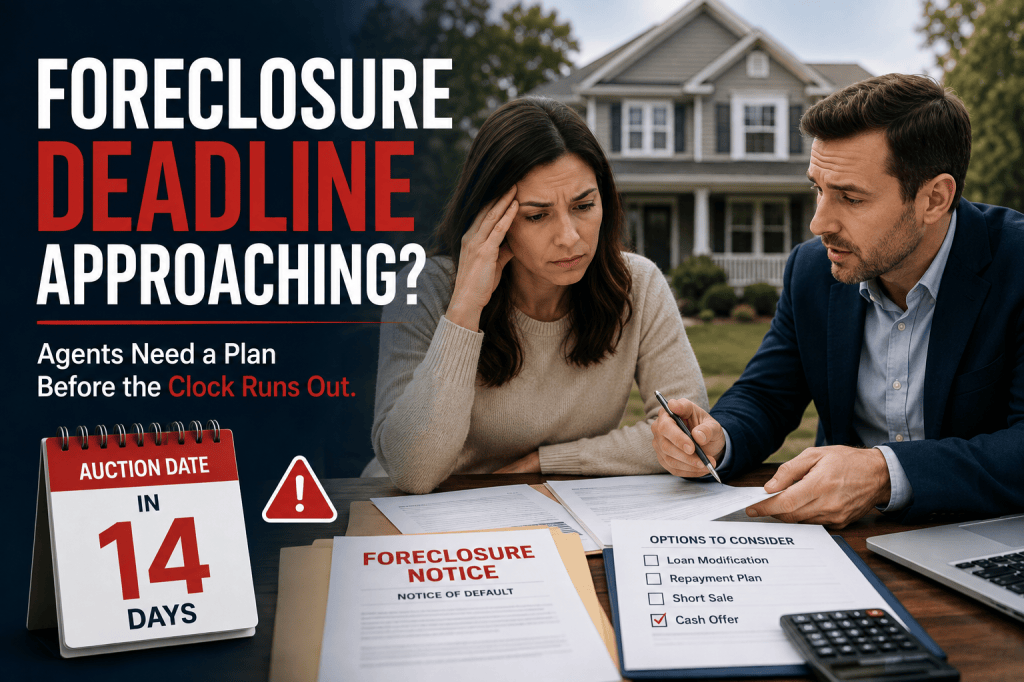
An estate client walked into Robert’s office in absolute despair.
After a series of legal setbacks and missed payments, the bank had issued a default notice and a foreclosure auction was scheduled for the family property in just fourteen days.
The seller still had significant equity in the property, but time had suddenly become the biggest problem.
In the EasyHomeSaleAgent.com Growth Playbook example, Robert explored an urgent institutional-buyer path rather than relying only on a traditional financed retail transaction.
The example describes a cash transaction that moved quickly enough for the seller to resolve the property situation before the scheduled auction and preserve remaining equity.
Foreclosure situations require more than a normal listing strategy
Agents can help with the real estate side of the problem, but foreclosure laws, deadlines, lender requirements, and homeowner remedies vary. Sellers should also contact their mortgage servicer and appropriate legal or housing-counseling professionals as quickly as possible.
The First Priority Is Understanding the Actual Deadline
“I’m in foreclosure” can describe several different stages of the process.
A homeowner may simply be behind on payments. A formal foreclosure process may have started. A sale date may already be scheduled.
Those distinctions matter.
Foreclosure procedures differ by state, and the amount of time available can vary considerably.
An agent should immediately clarify:
- Has the homeowner received a formal foreclosure notice?
- Is there already a scheduled sale or auction date?
- Who is the mortgage servicer?
- How much is currently owed?
- Are there additional liens or judgments?
- What does the seller ultimately want to accomplish?
Get the Mortgage Servicer Involved Immediately
A real estate agent should not assume that selling the property is the homeowner’s only possible solution.
The Consumer Financial Protection Bureau recommends that homeowners having trouble making mortgage payments contact their mortgage servicer as soon as possible.
Depending on the loan and circumstances, borrowers may have options involving repayment plans, forbearance, loan modification, short sale, deed-in-lieu, or other forms of loss mitigation.
Important
Don’t tell a seller that a sale is their only option before they understand what their servicer and qualified advisors may offer.
Know Where the Agent’s Role Ends
Foreclosure can involve legal rights, lender rules, bankruptcy questions, taxes, title issues, and state-specific deadlines.
Those issues may go beyond the scope of a real estate license.
The agent’s role is strongest when focused on the property and transaction:
- Understanding likely market value
- Estimating potential selling costs
- Reviewing realistic buyer demand
- Helping the seller evaluate possible sale paths
- Coordinating title and transaction professionals
- Helping execute a sale if that becomes the seller’s chosen path
Equity Changes the Conversation
One of the most important numbers in an urgent sale is the homeowner’s potential equity.
If a property may be worth substantially more than the debt and selling costs attached to it, the homeowner may have value worth protecting.
Agents can help estimate the real estate side of that equation.
A useful starting calculation
Estimated sale proceeds minus mortgages, liens, transaction costs, and other amounts due can help the seller understand what may remain after a successful sale.
That estimate should be confirmed with the appropriate title, closing, legal, and lender professionals before the seller relies on it.
When a Traditional Listing May Still Work
A foreclosure notice does not automatically mean a traditional MLS strategy is impossible.
If enough time remains and the property is marketable, broad market exposure may still be a viable path.
The agent needs to evaluate the timeline realistically.
| Question | Why It Matters |
|---|---|
| How much time remains? | Marketing, negotiation, financing, appraisal, title, and closing all take time. |
| What is the property’s condition? | Significant repairs may reduce retail buyer demand or create financing complications. |
| What is current buyer demand? | A highly marketable home may create options more quickly than a difficult property. |
| Can the required parties cooperate quickly? | Lenders, title professionals, attorneys, buyers, and sellers may all have deadlines and documentation requirements. |
When Speed Becomes the Seller’s Biggest Priority
As a foreclosure sale date approaches, the seller’s priorities may shift.
They may no longer be comparing only the highest possible sale price.
They may also be thinking about:
Time
Is there realistically enough time to complete the chosen transaction?
Certainty
How much transaction risk can the seller tolerate this late in the process?
Equity
What potential proceeds may remain if a sale can be completed?
Where a Cash Buyer May Become Relevant
A genuine cash buyer does not rely on a traditional mortgage approval process.
That can remove some of the financing steps that may make a conventional transaction slower or less predictable.
For a homeowner facing a very short deadline, that difference may be worth evaluating.
Where EasyHomeSaleAgent.com fits
EasyHomeSaleAgent.com can help agents explore potential institutional-buyer interest when an urgent seller needs to compare an alternative cash path with a traditional market strategy.
A Cash Offer Is Not the Same as a Guaranteed Foreclosure Rescue
This distinction is extremely important.
The Robert scenario in the playbook describes one transaction that moved quickly enough to resolve the situation before the scheduled auction.
Agents should not turn that outcome into a promise that every cash transaction can stop a foreclosure sale.
Whether a sale can be completed in time depends on the actual foreclosure status, applicable law, title, lender requirements, liens, buyer terms, property eligibility, documentation, and many other factors.
Never promise that a transaction will stop a foreclosure until the appropriate professionals have confirmed what is required.
Agents Need a Rapid-Response Workflow
Urgent sellers cannot be handled like normal nurture leads.
If a client tells you that an auction is approaching, organize the information immediately.
Identify the exact notices received and any scheduled foreclosure sale date.
Encourage immediate contact with the mortgage servicer, a HUD-approved housing counselor, and legal counsel when appropriate.
Determine likely value, condition, marketability, debt, and potential equity.
Compare open-market exposure with alternative buyer options based on the actual time available.
In an urgent transaction, small delays in documents, title, signatures, or communication can matter.
Be Especially Careful With Foreclosure Scams
Financially distressed homeowners can be vulnerable to people promising guaranteed rescue.
The CFPB warns homeowners about companies that demand upfront fees, guarantee they can stop foreclosure, tell borrowers to stop communicating with their servicer, or pressure homeowners into signing documents they do not understand.
Agents should reinforce the opposite behavior: involve legitimate professionals, document the transaction, and never make guarantees that cannot be supported.
Sometimes the Best Value an Agent Provides Is Organization
Foreclosure situations are stressful because several problems are happening at the same time.
The homeowner may be dealing with the lender, legal notices, family members, money problems, moving decisions, and the property itself.
An agent who can calmly organize the real estate side of the situation can still provide significant value.
That does not mean having every answer.
It means knowing which questions belong to you, which professionals need to be involved, and which transaction paths deserve serious consideration.
Key Takeaways for Agents
- Treat an approaching foreclosure deadline as an urgent situation.
- Confirm the actual foreclosure stage and relevant dates before discussing strategy.
- Encourage the seller to contact their mortgage servicer and qualified housing or legal professionals.
- Help estimate property value, debt, potential equity, and realistic sale timing.
- Compare traditional and alternative buyer paths based on the actual time available.
- Never guarantee that a particular transaction will stop a foreclosure.
Frequently Asked Questions
Can a homeowner sell a house while it is in foreclosure?
Depending on the foreclosure stage, applicable state law, loan status, liens, lender requirements, and timing, a homeowner may still be able to sell the property before a foreclosure sale. The homeowner should confirm their specific situation with their mortgage servicer and appropriate legal or housing professionals.
Can a real estate agent stop foreclosure?
A real estate agent does not control the foreclosure process. An agent may be able to help execute a property sale if that is an appropriate option, while the homeowner works with the mortgage servicer, attorney, housing counselor, and other professionals regarding the foreclosure itself.
Where can a homeowner get foreclosure help?
The Consumer Financial Protection Bureau recommends contacting the mortgage servicer and a HUD-approved housing counseling agency. Homeowners facing an imminent foreclosure or legal papers may also need qualified legal advice.
For Real Estate Professionals
Urgent sellers need realistic options quickly.
See how EasyHomeSaleAgent.com can help agents explore potential institutional-buyer options when a seller needs to compare an alternative transaction path.
See How It WorksThe Robert scenario is based on an example in the EasyHomeSaleAgent.com Growth Playbook. Foreclosure laws, deadlines, homeowner rights, lender requirements, transaction terms, title conditions, buyer availability, and outcomes vary. This article is for general educational purposes for real estate professionals and is not legal, tax, or foreclosure advice.


Leave a comment