
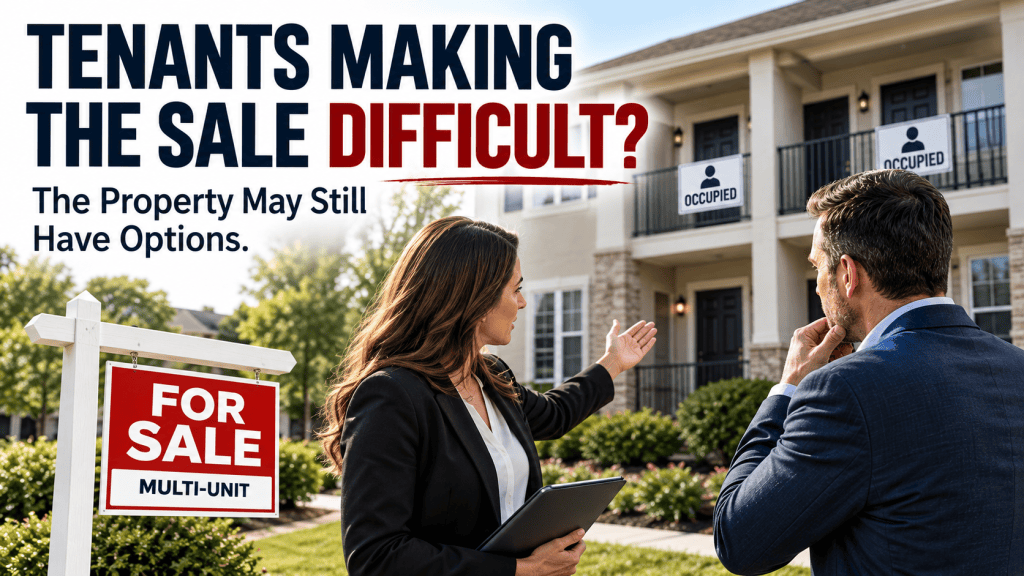
Clara’s investor client had a straightforward goal: liquidate a four-unit residential portfolio and free up capital for the next opportunity.
The problem was that two of the units were occupied by non-paying tenants who were not cooperating with the owner’s plans.
Traditional showings were becoming difficult, the seller did not want the properties sitting in limbo indefinitely, and the entire portfolio exit strategy was slowing down.
In the EasyHomeSaleAgent.com Growth Playbook example, Clara explored an institutional-buyer path for the tenant-occupied assets instead of relying only on a traditional retail sale.
The bigger lesson for agents
A difficult tenant situation does not automatically make an investment property unsellable. It may simply change the buyer pool, transaction structure, and strategy the owner needs to consider.
Selling an Occupied Investment Property Is Different
A rental property is not always delivered vacant just because the owner decides to sell.
The property may have active leases, month-to-month tenants, unpaid balances, pending notices, maintenance disputes, or other occupancy issues.
Those details can affect what buyers are willing to consider and what the seller can realistically do before closing.
Before marketing the property, agents should understand:
- Which units are occupied
- Whether leases are in place
- Lease expiration dates
- Current rent and payment status
- Any unresolved tenant issues
- Whether the owner expects vacant possession
- How much access buyers can realistically get
Start With the Lease File, Not the Photography
On a normal residential listing, the first conversation may be about staging, photos, and pricing.
With a tenant-occupied investment property, the documentation can matter just as much as the physical condition.
A serious investor may want to understand the income stream, leases, expenses, tenant history, and operational issues before thinking about cosmetic presentation.
Investor mindset
The property may be a home to the tenant, but to the buyer it is also an operating asset.
Showings Can Become the Biggest Practical Problem
Occupied properties can be harder to show than vacant investment properties.
Tenants have their own schedules, privacy concerns, lease rights, and expectations about access.
If the relationship between the owner and tenant is already strained, repeated buyer showings can become even more difficult.
That does not mean the agent should ignore access rules or push tenants into uncomfortable situations.
Access should be handled according to the lease, applicable rules, and the property’s actual occupancy situation.
A Non-Paying Tenant Does Not Automatically Mean the Property Has No Value
A tenant issue can absolutely affect the value, timing, and complexity of a sale.
But some buyers may be willing to evaluate the property with the occupancy situation already in place.
Investors often evaluate problems differently from owner-occupant buyers.
Instead of asking only, “Is this property move-in ready?” they may ask:
- What is the current rent roll?
- What could the property produce once stabilized?
- What management or legal work may be required?
- What repairs are needed?
- How does the purchase price account for the risk?
- What is the long-term investment opportunity?
The Buyer Pool May Need to Change
A retail buyer who wants a vacant property may have little interest in inheriting an active tenant situation.
A professional investor may view that same property differently.
| Buyer Type | Possible Perspective |
|---|---|
| Owner-Occupant Buyer | May prioritize possession, condition, financing, and the ability to occupy the property. |
| Small Investor | May evaluate rental income, tenant status, repair costs, and management needs. |
| Institutional Buyer | May evaluate the property as part of a broader rental or investment strategy, depending on its acquisition criteria. |
Where EasyHomeSaleAgent.com Fits
The original playbook example uses EasyHomeSaleAgent.com to expose Clara’s multi-unit portfolio to institutional buyers interested in tenant-occupied assets.
Another buyer path
EasyHomeSaleAgent.com can help agents explore potential institutional-buyer interest for suitable investment properties so the owner can compare that path with a traditional market sale.
Don’t Promise That a Buyer Will Take Over Every Tenant Problem
This is where the public article needs to be more cautious than the original playbook.
The Clara example describes a buyer willing to purchase the occupied assets and handle the tenant situation after closing.
That does not mean every buyer will accept unpaid rent, ongoing disputes, existing leases, or unresolved possession issues.
Actual buyer requirements, pricing, lease reviews, title conditions, due diligence, closing terms, and occupancy requirements vary.
Let the actual offer and transaction documents determine what the buyer is accepting.
Selling Before Resolving the Tenant Issue May Be Worth Comparing
Some owners may choose to resolve tenant matters before marketing the property.
Others may prefer to sell the property with the tenant situation in place if a qualified buyer is willing to take on that complexity.
The decision should be based on the actual economics and legal circumstances, not on an assumption that one approach is always better.
Compare both paths
“What would it cost in time and money to resolve the tenant situation first, and what would a buyer pay to take on the property in its current condition?”
Portfolio Sellers Think Differently From One-Home Sellers
Clara’s client was not selling one personal residence.
The investor wanted to liquidate several units and redeploy capital.
That changes the conversation.
Capital
How much equity does the investor want to free up?
Timing
Does the investor need liquidity for another acquisition or business purpose?
Portfolio Strategy
Are they exiting one asset or restructuring several properties?
Operational Burden
How much management complexity are they trying to remove?
Organize the Property File Before Approaching Buyers
Investment-property buyers usually want clarity.
A well-organized file can make the property easier to evaluate.
Depending on the property, useful information may include:
- Current rent roll
- Copies of leases
- Operating expenses
- Property condition information
- Payment history
- Utility responsibilities
- Security deposit records where applicable
- Known tenant or maintenance issues
Know When You Need Legal Guidance
Tenant-occupied sales can intersect with landlord-tenant law, leases, notices, possession rights, deposits, local ordinances, and other legal issues.
The agent should not invent answers to those questions.
When legal rights or obligations are unclear, the investor should work with qualified legal counsel or the appropriate property-management professionals.
The agent can organize the real estate strategy without becoming the landlord’s attorney.
Build a Tenant-Occupied Sale Checklist
Identify who occupies each unit and under what arrangement.
Gather leases, rent information, expenses, and relevant property records.
Determine whether price, speed, liquidity, or reducing management burden matters most.
Consider investors comfortable with occupied properties rather than assuming the property needs to be vacant first.
Let the investor evaluate timing, price, tenant complexity, costs, and transaction terms.
Difficult Tenants Can Still Be an Investment Conversation
The most important takeaway from Clara’s example is not that every tenant problem has an easy solution.
It is that agents working with investors should avoid automatically treating complicated occupancy as a dead end.
There may be buyers who evaluate the property based on the underlying asset and are willing to consider the operational problems as part of the purchase.
The agent’s job is to identify those realistic paths and help the investor compare them.
Key Takeaways for Agents
- Tenant-occupied properties require a different sale strategy from vacant homes.
- Understand leases, occupancy, rent status, and buyer-access limitations early.
- A tenant issue may change the buyer pool without eliminating the property’s value.
- Investor sellers often care about liquidity and portfolio strategy as much as the individual property.
- Compare resolving the tenant situation first with selling to a buyer willing to evaluate it in place.
- Keep legal questions with qualified professionals and focus the agent’s role on organizing the transaction options.
Frequently Asked Questions
Can an investor sell a property with tenants still living in it?
Tenant-occupied properties can be sold in many situations, but leases, tenant rights, possession, notices, disclosures, and other requirements depend on the property and jurisdiction. The seller should obtain appropriate legal guidance where needed.
Do tenants have to leave when a rental property is sold?
Not necessarily. The answer depends on the lease, applicable law, transaction terms, and the circumstances of the tenancy. Agents should not promise vacant possession without confirming what is legally and contractually possible.
Will investors buy properties with difficult tenants?
Some investors may consider tenant-occupied properties or properties with management challenges, while others may require different occupancy conditions. Buyer criteria and pricing vary.
For Real Estate Professionals
A difficult tenant situation may require a different buyer, not a dead listing.
EasyHomeSaleAgent.com can help agents explore potential institutional-buyer options for suitable tenant-occupied investment properties alongside a traditional market strategy.
See How It WorksThe Clara scenario is based on an example in the EasyHomeSaleAgent.com Growth Playbook. Tenant rights, leases, landlord obligations, possession, notices, buyer criteria, transaction terms, and legal procedures vary. This article is for general educational purposes for real estate professionals and is not legal or landlord-tenant advice.


Leave a comment