
Most homeowners in your database are not planning to sell this month.
That does not mean they are bad leads.
It means your job is different.
Instead of trying to force a transaction, you need to stay useful long enough to be remembered when the transaction eventually happens.
Your database does not need more “checking in” messages
It needs information homeowners actually have a reason to care about.
Why Real Estate Databases Go Cold
Agents usually do a great job staying in touch while someone is actively buying or selling.
Then the transaction closes.
Communication slows down.
Six months becomes a year.
Eventually, the homeowner remembers the agent as someone they once worked with rather than the person they would automatically call again.
Database follow-up often fails because it becomes:
- Too infrequent
- Too sales-focused
- Too generic
- Dependent on the agent remembering to do it
- Useful only when someone is already ready to transact
Stop Treating Every Contact Like a Lead That Needs to Convert Today
A homeowner who bought three years ago may have no intention of selling right now.
But they may still care about:
- What their home may be worth
- What is happening in their neighborhood
- Recent nearby sales
- Local events
- Property maintenance
- Interest rates and affordability
- What options they would have if life suddenly changed
Better nurture strategy
Give homeowners information they would still want even if they were not planning to hire you today.
Home Value Updates Are a Natural Reason to Stay in Touch
Homeowners are naturally curious about their property value.
That makes home-value information one of the easiest ways for a real estate professional to remain relevant after the transaction closes.
The important part is how the information is presented.
An automated estimate can provide a useful starting point, but it should not automatically be presented as a precise appraisal or guaranteed sale price.
Local market context still matters.
Mix Real Estate With Local Information
If every message is about buying or selling, homeowners eventually learn to ignore the messages unless they are actively moving.
Local content gives you more reasons to communicate.
Useful topics may include:
- Neighborhood events
- New businesses
- Local market activity
- Seasonal homeowner tips
- Recent nearby sales
- Community updates
- Property-related reminders
The Goal Is Recognition Before the Real Estate Need Appears
Most homeowners do not wake up one morning and immediately hire an agent.
The idea usually develops over time.
Maybe they are considering moving closer to family.
Maybe another child is coming.
Maybe a job changed.
Maybe the house suddenly feels too large.
You want your name to already be familiar when that conversation begins.
The best database follow-up often creates familiarity before it creates a lead.
Consistency Matters More Than Constant Contact
Staying top-of-mind does not mean messaging someone every few days.
Too much communication can become noise.
A predictable monthly touchpoint can often be more useful than random bursts of follow-up whenever the agent remembers.
Automation Solves the Consistency Problem
The biggest problem with database marketing is rarely knowing what to do.
It is doing it every month.
Agents get busy.
Listings happen.
Closings happen.
Lead follow-up takes priority.
Suddenly, the database has not heard from the agent in six months.
Automation can prevent that gap.
Automate the routine
Use automation to guarantee consistency, then add personal communication when the situation calls for it.
Automation Should Not Replace Personal Follow-Up
A monthly digest keeps the relationship warm.
It should not become the entire relationship.
Important clients, past clients, referral partners, and homeowners showing signs of interest still deserve personal communication.
The automated layer makes sure nobody disappears simply because the agent got busy.
Watch for Engagement Signals
Database nurture becomes more powerful when agents pay attention to what contacts engage with.
Someone repeatedly checking their home value or exploring seller options may deserve a different follow-up than someone who has not interacted in months.
That does not mean assuming they are ready to sell.
It simply gives the agent a more relevant reason to reach out.
Give Homeowners More Than One Selling Conversation
Some homeowners want to know their estimated market value.
Others are curious about what an as-is or cash option might look like.
Some want both.
Agents who can discuss multiple paths have more ways to be useful when a homeowner eventually starts considering a move.
Where EasyHomeSaleAgent.com Fits
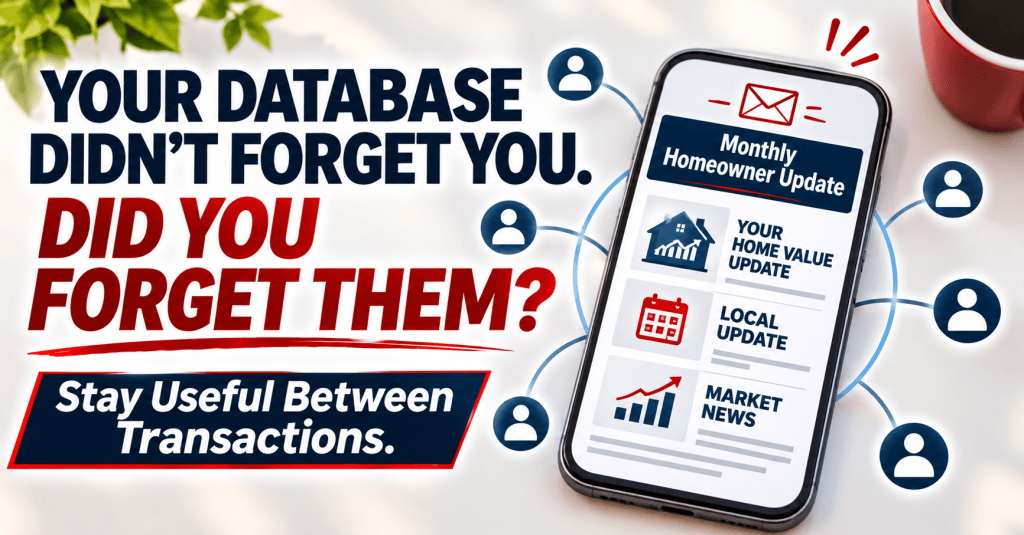
The EasyHomeSaleAgent.com playbook includes an automated monthly Home Digest as part of its agent platform.
The digest is designed to keep participating agents in front of their contacts with homeowner-focused information such as home values, local content, seller options, and agent updates. :chatgpt-content-reference{index=”1″}
Stay relevant between transactions
EasyHomeSaleAgent.com combines monthly homeowner nurturing with seller-option tools so agents have a reason to remain useful long before a homeowner is ready for another transaction.
Don’t Make Every Message About You
“I just sold another home.”
“I won another award.”
“Call me if you’re thinking of selling.”
There is nothing wrong with occasionally sharing accomplishments.
But if every communication is about the agent, homeowners have little reason to keep paying attention.
Make the majority of the content useful to them.
| Weak Database Message | More Useful Alternative |
|---|---|
| “Thinking of selling?” | “Here’s what’s happening with home values in your area.” |
| “Know anyone who needs an agent?” | “Here are three things homeowners should know this month.” |
| “Checking in!” | “A home nearby just sold. Here’s why it may matter to your property value.” |
A Simple Database Nurture System
Organize past clients, homeowners, leads, referral partners, and other contacts.
Give contacts something useful enough to remain worth opening.
Make sure communication continues even during your busiest months.
Use meaningful activity as a reason for more personal follow-up.
Treat the transaction as the beginning of the long-term relationship rather than the end.
Key Takeaways for Agents
- Most database contacts are future opportunities, not immediate transactions.
- Useful homeowner information creates a natural reason to stay in touch.
- Home values and local updates can keep communication relevant.
- Automation helps prevent long gaps in follow-up.
- Automated nurturing should support rather than replace personal relationships.
- Being remembered when the real estate need appears is often more important than constantly asking whether someone is ready to sell.
Frequently Asked Questions
How often should real estate agents contact their database?
There is no single schedule that fits every database, but regular useful communication is generally more effective than disappearing for months and then sending a sudden sales request. A monthly value-focused touchpoint can create a consistent baseline.
What should real estate agents send past clients?
Useful topics can include home-value information, neighborhood updates, local events, homeowner tips, market changes, and relevant property-selling options rather than only asking for referrals.
Should real estate database follow-up be automated?
Automation can help maintain consistency, but it works best as the baseline of a larger relationship strategy that also includes personal communication when appropriate.
Stay Top-of-Mind
Give your database a reason to remember you before they need an agent.
EasyHomeSaleAgent.com includes automated homeowner nurturing alongside its seller-option platform for participating agents.
See How It Works

Leave a Reply