
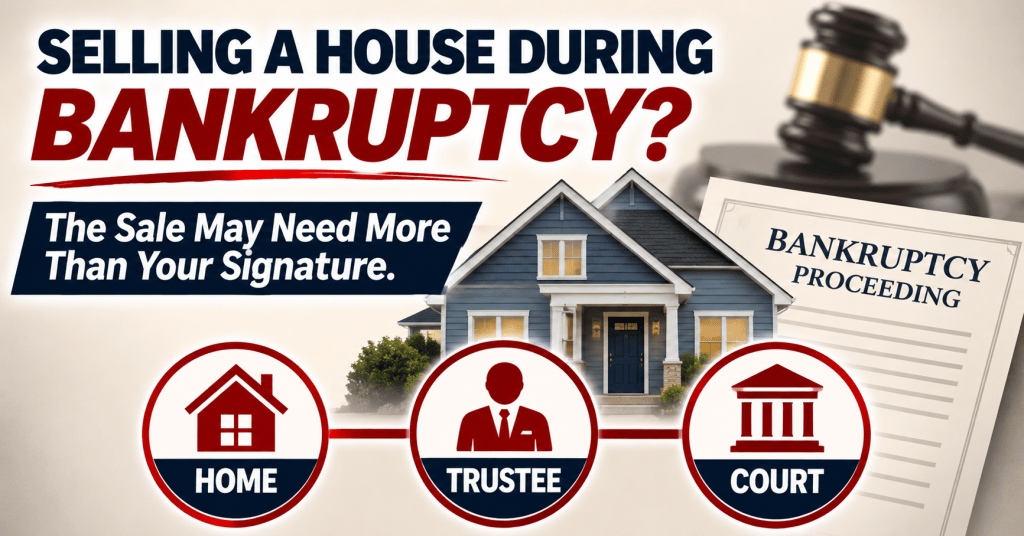
Selling a home is already a major financial transaction.
Selling one while bankruptcy or another court-supervised financial process is underway can add an entirely different layer of complexity.
There may be a trustee involved.
There may be liens or creditor claims.
Court approval may be required.
And the homeowner may not have the same freedom to accept an offer that they would in an ordinary sale.
Bankruptcy changes who may need to approve the sale
Before listing or accepting an offer, homeowners should understand who controls the property, what approvals may be required, and how the proceeds will be handled.
Start With the Bankruptcy Attorney
A homeowner considering a sale during bankruptcy should not begin by assuming a normal real estate process applies.
The bankruptcy attorney should be involved early.
The attorney can help explain how the property fits into the case, what authority the homeowner has, what role the trustee plays, and whether court approval may be necessary.
Do not accept an offer first and ask about bankruptcy requirements later.
Who Actually Controls the Property?
That answer can depend on the bankruptcy chapter, case status, exemptions, court orders, trustee involvement, and other factors.
In some situations, the debtor may retain significant control.
In others, the trustee may have authority over the property or sale process.
Agents should confirm this before marketing the home or negotiating terms.
Understand the Equity Position
One of the most important questions is how much equity exists in the property.
Start with a realistic market value and compare that with the debts and costs attached to the property.
That may include:
- First mortgage payoff
- Second mortgages or HELOCs
- Tax liens
- Judgment liens
- HOA obligations
- Transaction expenses
- Other claims affecting the property
Equity Does Not Automatically Mean the Seller Keeps It
In an ordinary sale, homeowners often think of equity as the amount left after paying the mortgage and transaction costs.
Bankruptcy may change how those proceeds are treated.
Exemptions, creditor claims, trustee decisions, and court orders may affect how sale proceeds are distributed.
This is another reason legal guidance is essential.
Important distinction
Having equity in the home and being entitled to personally receive all of that equity are not necessarily the same thing.
The Sale Price May Need to Be Supported
A bankruptcy-related sale may receive more scrutiny than an ordinary transaction.
The parties involved may want evidence that the proposed sale reflects a reasonable market result.
That makes pricing documentation especially important.
Useful support may include:
- Comparable sales
- Broker price opinions or CMAs
- Appraisals where required
- Property-condition documentation
- Repair estimates
- Competing offers where available
Court Approval May Affect the Timeline
Depending on the case, a proposed sale may require notice, trustee involvement, court approval, or other procedural steps.
That means the real estate closing date needs to match the legal timeline.
Agents should avoid promising a standard closing schedule until they understand those requirements.
A Fast Buyer Cannot Skip the Legal Process
This is an important distinction.
A cash buyer may be able to move quickly once the transaction is legally cleared to proceed.
But using cash does not automatically eliminate trustee review, court requirements, title issues, liens, or other obligations.
Cash can simplify financing. It cannot override bankruptcy law or court requirements.
Why Financing Risk Can Matter
Once a transaction receives the necessary approvals, a seller may prefer to reduce the chances of the deal failing because of buyer financing.
A financed buyer may still need to satisfy appraisal, underwriting, property-condition, and loan-program requirements.
A cash buyer removes conventional mortgage underwriting from the transaction, although other diligence may remain.
Compare the Whole Offer
The highest purchase price is not the only consideration in a court-sensitive transaction.
| Offer Factor | Why It Matters |
|---|---|
| Purchase Price | Helps establish the proposed value being paid for the asset. |
| Financing | Can affect transaction risk and closing requirements. |
| Due Diligence | Determines what the buyer may still investigate or renegotiate. |
| Closing Timeline | Needs to work with court, trustee, title, and transaction requirements. |
| Proof of Funds / Qualification | Helps evaluate the buyer’s ability to complete the purchase. |
Liens Need to Be Identified Early
Financial distress can sometimes mean the title contains more than a normal mortgage.
Tax liens, judgments, association claims, secondary loans, or other obligations may need to be addressed before closing.
Ordering title work early can help identify issues before they become last-minute surprises.
Property Condition Still Matters
Financial hardship can sometimes coincide with deferred maintenance.
If the seller has limited funds available for repairs, the agent may need to compare a traditional prepared listing with an as-is strategy.
The appropriate legal approvals still apply regardless of the property condition.
Where EasyHomeSaleAgent.com Fits
The playbook recommends having institutional-buyer options available when a seller needs to compare buyers with different financing and transaction structures.
Add another buyer path to the comparison
EasyHomeSaleAgent.com can help participating agents explore preliminary institutional-buyer options alongside traditional marketing when the appropriate legal professionals determine that a property may be sold.
Buyer availability, property eligibility, preliminary pricing, court requirements, trustee approval, title issues, diligence, and final terms vary.
Agents Should Stay in Their Lane
Bankruptcy is a legal and financial process.
Real estate agents can provide property information, market analysis, buyer options, and transaction coordination.
They should not tell clients how to structure a bankruptcy case, predict what a judge or trustee will approve, or advise them on exemptions or creditor rights.
Those questions belong with the client’s attorney and other qualified professionals.
The agent’s role
Help the client understand the real estate options while the legal professionals guide the bankruptcy process.
A Simple Bankruptcy Property-Sale Checklist
Determine whether the property may be sold and what approvals are required.
Understand the roles of the homeowner, trustee, court, and other parties.
Review estimated value, mortgage payoffs, title claims, and transaction expenses.
Have market information supporting the proposed transaction.
Evaluate price, terms, financing, diligence, and realistic closing requirements.
Key Takeaways
- Selling property during bankruptcy may require additional legal and court procedures.
- Involve the bankruptcy attorney before listing or accepting an offer.
- Understand who has authority to approve the transaction.
- Equity, exemptions, liens, and creditor claims can affect sale proceeds.
- Cash buyers can remove conventional mortgage financing risk but cannot bypass legal requirements.
- Agents should provide real estate guidance while leaving bankruptcy advice to qualified legal professionals.
Frequently Asked Questions
Can you sell your house while in bankruptcy?
It may be possible, but the process depends on the bankruptcy case, property status, exemptions, trustee involvement, court requirements, and other circumstances. Homeowners should consult their bankruptcy attorney before proceeding.
Do you need court approval to sell a home during bankruptcy?
Court or trustee approval may be required depending on the case and bankruptcy chapter. The homeowner’s attorney can explain the process that applies to the specific situation.
What happens to the money when a house is sold during bankruptcy?
Distribution of the proceeds can depend on mortgages, liens, exemptions, creditor claims, trustee authority, and court orders. Sellers should get guidance from their bankruptcy attorney rather than assuming the remaining equity will automatically be paid directly to them.
Selling During a Financial Restructuring?
Understand the legal process first. Then compare the real estate options.
EasyHomeSaleAgent.com can help participating agents explore preliminary institutional-buyer options alongside traditional selling strategies when a sale is legally permitted.
See How It WorksThis article is for general educational purposes and is not bankruptcy, legal, tax, financial, or investment advice. Bankruptcy procedures, court requirements, exemptions, liens, creditor claims, property rights, transaction terms, and individual circumstances vary.


Leave a Reply